Tenant Improvement Construction in Seattle: What Landlords & Tenants Need to Know
Signing a lease on a commercial space in Seattle is just the beginning. Before your team moves in, before customers walk through the door, and before a single piece of furniture is placed — the space often needs to be completely transformed. That transformation is called a tenant improvement (TI), and it is one of the most consequential construction decisions a landlord or tenant will make.
Whether you are a property owner trying to attract and retain high-quality tenants, or a business looking to build out your ideal workspace, understanding how tenant improvement construction works in Seattle can save you significant time, money, and frustration.
This guide breaks down everything you need to know: what TI construction covers, how costs and responsibilities are split, what the permitting process looks like in Seattle, and how to choose the right commercial build-out contractor to get the job done right.
What Is Tenant Improvement Construction?
Tenant improvement (TI) construction, also called a commercial build-out — refers to the customization or renovation of a leased commercial space to meet a tenant's specific operational needs. This can range from minor cosmetic updates like new paint and carpet to full-scale structural renovations involving HVAC systems, electrical rewiring, plumbing, and custom millwork.
TI projects span virtually every commercial property type in Seattle:
Office spaces being reconfigured for open-plan collaboration or private executive suites
Retail storefronts requiring custom fixtures, signage infrastructure, and point-of-sale systems
Medical and dental clinics needing specialized plumbing, gas lines, and ADA-compliant layouts
Restaurants requiring commercial kitchen buildouts with ventilation, grease traps, and health department compliance
Industrial and flex spaces being converted for light manufacturing, warehouse, or tech use
No two TI projects are alike. The scope depends on the condition of the existing space (referred to as the 'shell condition'), the tenant's business requirements, and what the landlord has agreed to fund.
Landlord vs. Tenant: Who Pays for What?
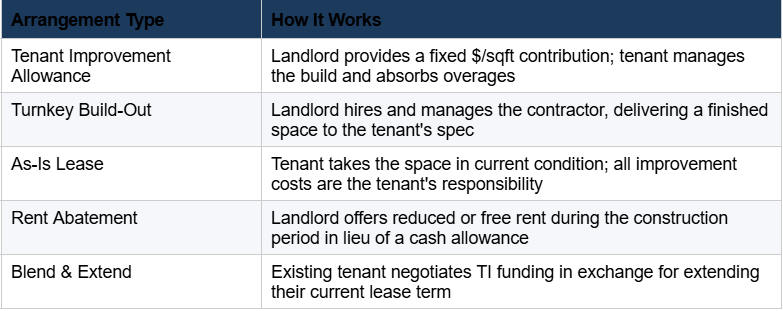
One of the most important — and often most misunderstood — aspects of tenant improvement construction is the question of financial responsibility. In Seattle's commercial real estate market, TI costs are typically negotiated as part of the lease agreement and structured in one of several ways.
Tenant Improvement Allowance (TIA)
The most common arrangement is the Tenant Improvement Allowance (TIA). In this model, the landlord agrees to contribute a fixed dollar amount — typically expressed as a per-square-foot figure — toward the cost of improvements. The tenant is responsible for any costs above that allowance.
In the Seattle metro area, TI allowances for Class A office space currently range from $50 to $120+ per square foot, depending on market conditions, lease term length, and tenant creditworthiness. Retail and industrial TI allowances are generally lower.
What the TI Allowance Typically Covers
Demolition of existing walls, ceilings, and finishes
New partition walls and framing
HVAC upgrades, ductwork, and controls
Electrical panels, wiring, and lighting systems
Plumbing rough-in and fixtures
Flooring, ceiling tiles, and paint
Doors, hardware, and storefront glass
Fire sprinkler and life safety systems
What Is Usually Excluded
Furniture, fixtures, and equipment (FF&E)
IT infrastructure, audio/visual systems, and cabling (sometimes negotiated in)
Branding, signage, and exterior graphics
Moving costs and temporary space
Business-specific specialty equipment
Important: Review Your Lease Language Carefully
TI allowances are only paid out once construction is complete and the landlord approves documented invoices.
Unused allowance typically does not convert to rent credit unless explicitly stated in the lease.
Some landlords require work to be performed by pre-approved contractors.
Improvements may revert to the landlord at lease end unless the lease specifies removal obligations.
The Tenant Improvement Construction Process in Seattle
Understanding the step-by-step construction process helps both landlords and tenants set realistic expectations around timeline, cost, and decision-making.
Step 1: Space Assessment & Pre-Construction Planning
Before any design or budgeting begins, an experienced office renovation contractor will conduct a thorough assessment of the existing space. This includes reviewing as-built drawings, evaluating the condition of existing MEP (mechanical, electrical, and plumbing) systems, identifying any code compliance gaps, and confirming the structural feasibility of planned changes.
In Seattle, older commercial buildings — especially those built before 1980 — may require seismic upgrades or asbestos abatement as part of the TI scope. These items should be identified early to avoid costly surprises.
Step 2: Design & Space Planning
Working with your contractor and architect, you will develop a space plan and construction drawings. For straightforward TI projects, design-build firms like Envision Builders can handle both design and construction under one contract, streamlining communication and reducing the risk of scope gaps.
Key decisions at this stage include ceiling heights, mechanical zoning, lighting design, ADA accessibility compliance, and finishes. Getting these right before permits are pulled avoids costly change orders later.
Step 3: Permitting Through the City of Seattle
All TI construction in Seattle that involves structural changes, electrical work, plumbing, mechanical systems, or occupancy changes requires permits from the Seattle Department of Construction and Inspections (SDCI). The permitting timeline varies significantly based on project complexity:
Project Type Typical Permit Timeline
Minor tenant improvements (no structural/MEP changes) 2–4 weeks (over-the-counter review)
Standard office build-out with MEP 6–12 weeks (standard SDCI review)
Complex build-outs (restaurants, medical, structural) 12–20+ weeks
Projects in landmark or historic buildings Additional historic review required
An experienced Seattle TI contractor will manage the permit application process on your behalf, coordinate with SDCI plan reviewers, and track inspections throughout construction to keep the project on schedule.
Step 4: Construction & Project Management
Once permits are issued, construction begins. A well-run TI project follows a clear sequence: demolition, rough framing, MEP rough-in, inspections, insulation, drywall, ceiling grid, flooring, paint, fixtures, and final finishes. Your general contractor should provide weekly progress updates, maintain a running RFI (Request for Information) log, and flag any unforeseen conditions immediately.
In a busy commercial building, your contractor must also coordinate work hours, elevator access, and noise restrictions with building management, something local Seattle contractors navigate routinely.
Step 5: Final Inspection & Occupancy
Before you can occupy the space, SDCI will conduct a final inspection and issue a Certificate of Occupancy (CO). Your contractor should prepare a punch list, a documented checklist of any outstanding items, and ensure all deficiencies are resolved before project closeout.
How Much Does Tenant Improvement Construction Cost in Seattle?
TI construction costs in Seattle vary widely based on the scope of work, quality of finishes, condition of the existing space, and current labor and material market conditions. Below are general benchmarks for common commercial build-out types as of 2024–2025:
Build-Out Type Estimated Cost Range (Per Sq Ft)
Basic office renovation (repaint, carpet, minor layout changes) $25 – $60
Mid-range office build-out with new partitions and MEP upgrades $75 – $140
High-end Class A office with custom finishes and AV systems $150 – $250+
Retail storefront build-out $60 – $150
Restaurant or food service (full kitchen) $200 – $400+
Medical or dental office $150 – $300
Warehouse or industrial conversion $20 – $80
These figures reflect hard construction costs only. Soft costs — including architectural fees (typically 8–15% of construction cost), permit fees, testing and inspections, and owner-side project management — should be factored into your total project budget.
Factors That Drive Cost Variation in Seattle TI Projects
Existing MEP infrastructure: older buildings with outdated electrical panels or HVAC often require significant upgrades
Ceiling height and open-plan configurations: more complex framing and ductwork routing increase labor costs
Union vs. non-union labor: both are prevalent in Seattle's commercial market and affect labor rates
Supply chain conditions: lead times on mechanical equipment and specialty finishes affect both cost and schedule
Neighborhood and building type: permitting complexity differs for projects in Downtown Seattle, South Lake Union, Bellevue, and other submarkets
Choosing the Right Seattle Tenant Improvement Contractor
The contractor you choose will have more impact on your TI project's success than any other single factor. Here is what to look for when evaluating office renovation contractors in Seattle:
Local Commercial Experience
TI construction in Washington State involves specific licensing requirements, union considerations, and familiarity with SDCI's permitting process. A contractor with a proven track record of completed commercial build-outs in Seattle — not just residential remodeling — brings knowledge that accelerates timelines and prevents compliance issues.
Design-Build Capability
Many TI projects benefit from a design-build delivery model, where a single firm handles both architectural design and construction. This reduces the coordination burden on the tenant or landlord and creates clearer accountability for cost, schedule, and quality.
Transparent Estimating
Request itemized bids, not lump-sum quotes. A detailed estimate allows you to understand exactly where your TI allowance is being spent and make informed decisions about where to invest in quality finishes versus where to value-engineer.
References From Similar Projects
Ask for references from completed TI projects of similar size and complexity. A contractor who has successfully delivered medical clinic build-outs, restaurant kitchens, or high-end office renovations in Seattle will bring directly applicable expertise to your project.
Envision Builders specializes in commercial construction in Seattle and the surrounding Puget Sound region, with deep experience in office, retail, and specialty tenant improvements. Explore our commercial construction services to learn more about our approach.
Tenant Improvement Tips for Landlords
If you own commercial property in Seattle, TI strategy is a critical lever for attracting and retaining tenants in a competitive market. Here are key considerations:
Structure your TI allowance competitively: Research current market allowances for your submarket and property class. An allowance that is too low signals that you are not serious about attracting quality tenants.
Specify a preferred contractor list — carefully: Requiring tenants to use specific contractors can save time and ensure quality, but only if those contractors are genuinely competitive on price and service.
Negotiate restoration obligations clearly: Be explicit in the lease about what improvements the tenant must remove at lease end. Ambiguity leads to disputes and unexpected costs.
Front-load due diligence: Before marketing a space for TI, invest in an as-built condition assessment so you can give accurate information to prospective tenants about what the space can support.
For landlords considering a speculative build-out or shell improvement prior to leasing, our commercial construction team can provide pre-lease construction consulting and budgeting services.
Tenant Improvement Tips for Tenants
Tenants entering their first commercial build-out often underestimate the complexity involved. Keep these principles in mind:
Engage a contractor before you sign the lease: Preliminary cost estimates from a TI contractor can help you negotiate a more appropriate allowance and avoid signing a lease that leaves you with a significant funding gap.
Get the landlord's approval process in writing: Most leases require landlord approval of plans before construction begins. Understand exactly what that process involves and how long it takes.
Build contingency into your budget: Even well-planned TI projects encounter surprises. Budget a 10–15% contingency on top of your contractor's estimate.
Understand the reimbursement process: TI allowances are typically reimbursed after construction is complete and documented. Plan your cash flow accordingly.
Do not skimp on MEP infrastructure: Underinvesting in mechanical, electrical, and plumbing systems creates operational headaches and expensive retrofit costs down the road.
Frequently Asked Questions: Tenant Improvement Construction in Seattle
How long does a typical tenant improvement project take in Seattle?
Timeline depends heavily on project scope. Simple cosmetic renovations may take 4–8 weeks. A standard mid-range office build-out with new partitions and MEP work typically runs 10–16 weeks from permit approval to occupancy. Complex build-outs — restaurants, medical facilities, or spaces requiring structural work — can take 5–9 months or longer. Permitting alone adds 6–20 weeks depending on SDCI review times and project complexity.
Can I start construction before permits are approved in Seattle?
In most cases, no. The Seattle Department of Construction and Inspections requires permits before work begins on any structural, electrical, plumbing, or mechanical scope. Some very limited cosmetic work — painting, carpet, non-structural shelving — may not require a permit, but your contractor should confirm this on a project-by-project basis. Starting work without required permits can result in stop-work orders, fines, and costly corrections.
Who owns the tenant improvements at the end of the lease?
In most commercial leases, improvements become the landlord's property at lease expiration unless the lease specifies otherwise. However, the lease may require the tenant to restore the space to its original condition — removing walls, flooring, or specialized systems — which can be expensive. This is a critical clause to negotiate carefully before signing.
What is a shell condition, and how does it affect TI costs?
A shell condition describes the state of a commercial space before any tenant-specific improvements. A 'cold dark shell' includes only the building structure and exterior — no HVAC, electrical distribution, plumbing, or finishes. A 'warm lit shell' includes basic HVAC distribution, electrical panels, restrooms, and lighting. The shell condition significantly affects TI costs: a cold dark shell requires substantially more investment to make occupancy-ready.
Does Envision Builders handle both design and construction for TI projects?
Yes. Envision Builders offers design-build delivery for commercial tenant improvement projects throughout the Seattle metro area. Our team works with your architect of record or provides in-house design coordination, manages all permitting through SDCI, and delivers a turnkey space on time and within budget.
What neighborhoods and submarkets does Envision Builders serve for commercial build-outs?
Envision Builders serves commercial clients throughout the greater Seattle area, including Downtown Seattle, South Lake Union, Capitol Hill, Bellevue, Redmond, Kirkland, Renton, and the broader Eastside and South King County markets. Contact us to discuss your specific project location.